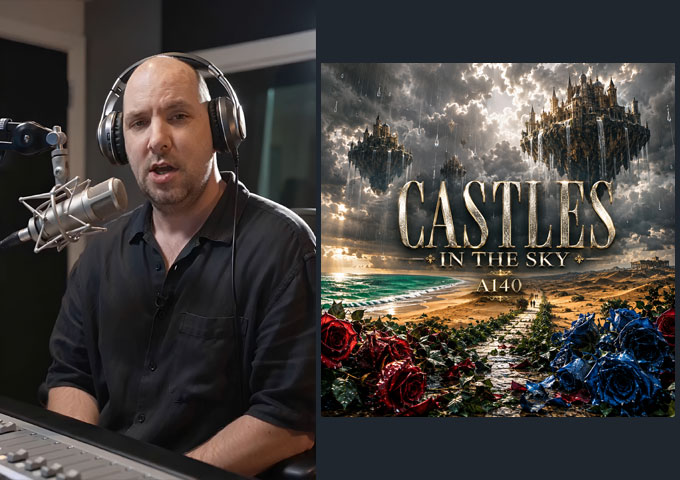
A140’s “Castles In The Sky” Finds Beauty in Love, Longing and the Pain of Memory
With “Castles In The Sky,” A140 turns romantic remembrance into an immersive lyrical experience. His performance carries the urgency of someone determined to preserve every meaningful moment before it disappears. The production balances hard-hitting hip-hop energy with luminous piano textures that complement the song’s dreamlike imagery. Beneath the romance lies a more vulnerable examination of separation, loss and the fear of life without a soulmate. A140’s poetic approach gives the track an emotional resonance that extends well beyond its beat.
For A140, the music begins with the written word. The artist name of Dana McGlynn, a poet and songwriter born in Danbury, Connecticut, and raised in Virginia Beach, Virginia, A140 has spent much of his life cultivating poetry as a primary form of expression. His songs emerge from that literary foundation, transforming thoughts, observations, memories and lived experiences into music rather than treating songwriting as a separate creative discipline.
McGlynn lives with ongoing mental-health and medical challenges, including COPD, and creativity has become one of his most important means of expression. Listen closely to “Castles In The Sky” and that context gives its recurring images of escape, endurance and imagination an added gravity. Building a place above the world, somewhere the rules no longer apply, begins to sound less like fantasy and more like necessity.
“Castles In The Sky” does not feel like a conventional rap song built around a collection of punchlines or a narrowly defined hip-hop persona. Its driving force is narrative. The rhyme is there to propel the story, but the story itself is rooted in emotional recollection, romantic idealism and the almost mystical conviction that a meaningful relationship can survive circumstances that would normally destroy it.
Musically, the track immediately establishes a compelling contrast between weight and luminosity. A banging mid-tempo hip-hop rhythm supplies the foundation, with a rumbling bassline giving the production physical presence while shimmering piano keys introduce a more reflective, almost dreamlike dimension. That combination is perfectly suited to the song’s central metaphor. The beat keeps the feet on the ground while the piano seems to look upward, mirroring the tension between real-world separation and an imagined emotional space where conventional limitations no longer apply.
Above that instrumental architecture, the verses are delivered with an insistent, almost breathless flow. The performance has an effortless momentum, as though the memories have accumulated so intensely that they can no longer be contained by measured phrasing. The rhyme patterns frequently move quickly from one image to another, but the delivery remains understandable because the emotional objective is never obscured by technical showmanship. The rap serves the confession.
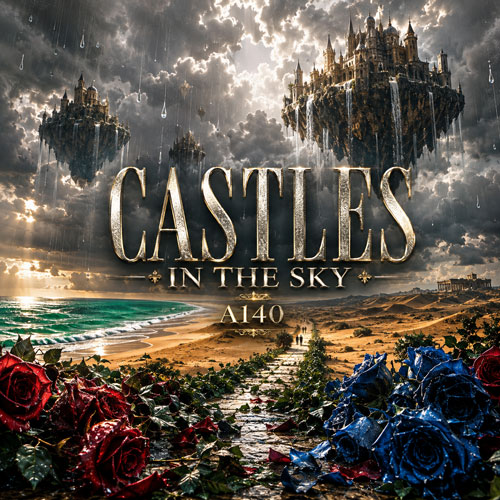
The opening immediately introduces the song’s defining metaphor: lovers constructing “castles in the sky.” Rather than presenting that phrase simply as a synonym for unrealistic dreaming, A140 gradually gives it greater emotional significance. The castle becomes a private world created by two people, an imagined refuge suspended above ordinary rules and circumstances. Flowers moving in the wind, morning solitude and the memory of a lover establish a landscape where physical absence is counterbalanced by emotional presence.
That relationship between memory and home is one of the song’s most affecting ideas. When the narrator suggests that the beloved’s memory is the only place that still feels like home, A140 turns remembrance into geography. Home is no longer necessarily a physical location. It becomes an emotional territory inhabited through recollection. This is a sophisticated poetic conceit because it allows the song to explore separation without reducing longing to simple sadness.
The narrative then becomes more personal and conversational. The recollection of the first kiss freezes time, transforming an ordinary romantic encounter into an event that becomes permanently preserved in memory. A140 combines this tenderness with flashes of playful confidence, including references to romantic competition and the narrator’s decision to commit himself exclusively. That mixture keeps the song from becoming excessively solemn. Love here is passionate, but it is also lived, complicated and occasionally cheeky.
A140’s imagery frequently works through unexpected collisions. The language repeatedly shifts between grounded details and heightened romantic symbolism, creating the impression of someone trying to describe a feeling that is ultimately larger than ordinary vocabulary can accommodate. This is also where the song’s repeated emphasis on loyalty becomes especially important. A140 is not presenting love as an uncomplicated fantasy. The lyrics acknowledge arguments, waiting, uncertainty and pain, then insist that genuine devotion is measured by the willingness to remain emotionally present through those complications.
The recurring chorus-like passage returns to the image of the lovers building their castles above the world, “miles above where rules don’t apply.” Its repetition gives the song an almost incantatory quality. Each return feels less like a simple refrain and more like a reaffirmation of the relationship’s imagined sanctuary. The castle is not merely a romantic destination. It is a psychological defense against circumstances that threaten to separate the couple.
Yet “Castles In The Sky” becomes considerably darker as it progresses. The romantic narrative eventually crosses the boundary between separation and mortality. References to flowers on a grave, frozen kisses and a blue rose introduce death into what initially appears to be an idealized love story. This tonal transformation is one of the track’s strongest artistic choices because it reveals that the song’s real subject is not simply romance. It is permanence.
The narrator’s determination to remain connected even beyond death gives earlier passages new meaning. The idea of loving someone into another lifetime pushes the song toward spiritual territory, but A140 keeps that spirituality connected to the intimate language of devotion. Angels, prayer, destiny and eternity are not introduced as abstract philosophical concepts. They emerge naturally from the desperation of someone who cannot accept that love should simply end because circumstances, distance or mortality demand it.
The final imagery is particularly poignant because it returns to the idea of carrying love through eternity. The song has traveled from a first kiss to separation, from romantic fantasy to grief, and finally toward an almost metaphysical promise that love remains meaningful regardless of how much time passes. The castle in the sky consequently becomes something more profound than an escapist fantasy. It represents the emotional architecture people build around the relationships they refuse to let disappear.
That literary instinct is central to understanding A140 as an artist. His work is informed by real-life experiences, including the ongoing challenges that have shaped his perspective, and creativity provides an important channel through which reflection, struggle, imagination, resilience and escape can coexist. His identity is therefore more accurately understood through the lens of poetry and songwriting than through the narrower categories of rapper, singer or producer. Collaborations provide the musical framework, but the written concept remains the heart of his expression.
That versatility is also evident beyond “Castles In The Sky.” The passionate pop ballad “Scent Of A Rose” reveals a softer and more openly melodic dimension, while “Golden Roses” leans into an orchestrally rich, sweeping American-songbook sensibility. “Soulmates”, meanwhile, brings an alternative-rock influence into a mid-tempo pop setting. Each of these latter tracks feature a female vocalist, adding a different texture to the compositions and demonstrating how comfortably A140 can move between musical environments without abandoning his fundamental identity as a writer.
That range makes the urban edge of “Castles In The Sky” all the more compelling. Rather than being confined to one stylistic formula, A140 uses hip-hop as the vehicle best suited to this particular story. The rhythmic intensity gives his words urgency, while the piano and bass allow the romantic and melancholic dimensions to breathe. The production does not overwhelm the poetry. It gives it momentum.
Ultimately, “Castles In The Sky” succeeds because its central metaphor becomes increasingly meaningful as the song unfolds. What begins as an image of lovers dreaming together develops into a portrait of memory, commitment, loss and transcendence. A140 takes the familiar language of romance and stretches it toward something more enduring, asking what remains when physical presence, distance and even mortality attempt to dismantle the bonds people create with one another.
For an artist whose creative life began with poetry, that feels entirely appropriate. A140 does not simply rap about love. He writes love as a landscape, builds it into architecture and then places that architecture somewhere beyond the reach of ordinary limitations. With its forceful hip-hop pulse, vivid imagery, emotionally direct performance and increasingly profound exploration of devotion, “Castles In The Sky” stands as a compelling example of how McGlynn’s poetry can become music without losing the intimacy that made it poetry in the first place.
OFFICIAL LINKS: SOUNDCLOUD