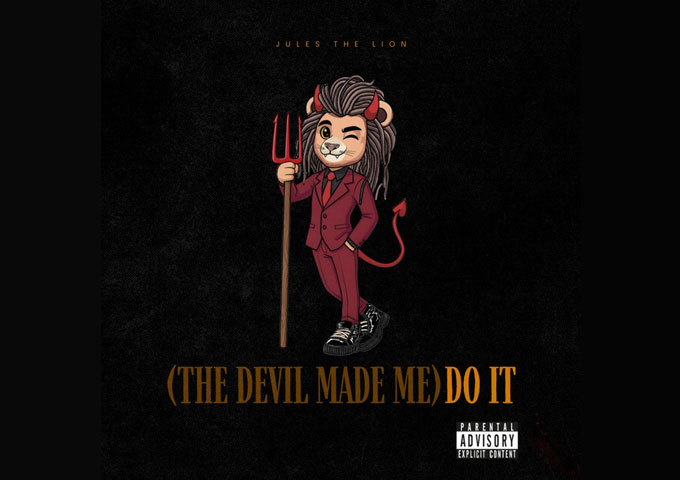
Jules the Lion Dares You to Blame the Devil on “(The Devil Made Me) Do It”
A queer R&B and hip-hop anthem that weaponizes temptation, self-awareness, and biblical mischief into one irresistibly seductive slow burn. Los Angeles artist Jules the Lion blends trap production, crunk-era whisper energy, and sharp lyrical wit into a track that refuses to apologize for desire. With charisma to spare and a wink at the scripture, Jules the Lion makes giving in sound like the most reasonable thing in the world.
There is something almost sacred about the way Jules the Lion opens (The Devil Made Me) Do It. Before the first verse even begins, a warning rings out, drawn straight from scripture, reminding the listener to be watchful for the enemy who prowls among them like a roaring lion. It is a preacher’s caution delivered with a comedian’s timing, and it sets the tone for everything that follows: a track that knows exactly how good it is, exactly how wrong it might be, and absolutely does not care.
Jules the Lion is a Los Angeles-based artist and comedian carving out a lane that very few occupy with this kind of ease. Rooted in storytelling, humor, vulnerability, and queer experience, their music draws from two wildly different childhood soundtracks, gospel echoing through church pews and gangsta rap rattling through bus speakers on the way to Venice Beach. That tension between the sacred and the street, between spiritual discipline and bodily desire, is not just a biographical footnote. It is the engine that powers (The Devil Made Me) Do It from first thump to final confession.
Produced and engineered by MinkMade, the track is built on gently slow-burning percussion that keeps the pulse low and deliberate, never rushing, always pulling. Shimmering keys float in the background like something you cannot quite place, somewhere between a church organ and a late-night R&B interlude. Over this, Jules the Lion deploys a vocal range that refuses to stay in one register for long, moving between a conspiratorial whisper, a melodic croon, and a sharper, more urgent rap delivery with the fluidity of someone who has been shapeshifting their whole life. The whispered rap section, in particular, recalls the playful and provocative energy of early-2000s crunk, specifically the kind of late-night mischief that the Ying Yang Twins perfected with their landmark “Whisper Song”. But where that track leaned entirely into its own outrageousness, Jules the Lion threads something more self-aware and layered through every bar.
The song’s concept is deceptively simple: temptation arrives, resistance crumbles, and blame gets outsourced to the nearest available supernatural entity. But the execution is anything but simple. The opening scenario drops the listener into a late-night phone call, the kind that should not be happening, the kind that arrives at demon time with heavy breathing and unspoken intent. What Jules the Lion does brilliantly in these early verses is hold a mirror up to a very specific and universal kind of human weakness. Someone has someone at home. The apple is right there. The knowing is already baked into the moment, and the question is not whether they will bite, but how long the performance of resistance will last.
The biblical imagery here is not decorative. It is structural. References to Eden, to wandering in the desert for forty days, to yielding to temptation after exhaustion erodes willpower, these are not casual name-drops. Jules the Lion grew up in gospel music. They understand the weight these stories carry, which is precisely what makes using them in this context so deliciously subversive. The serpent’s logic is reconstructed and handed back to the listener with a grin. Pleasure exists. Fear is what stands between you and it. Why should anyone deny themselves? It is an argument the song presents with full self-awareness that it is an argument, and that is exactly what makes it work.
The chorus becomes a kind of communal absolution, a chant that loops and escalates. The line between not wanting to do something and doing it anyway collapses under the weight of repetition until the two states become indistinguishable. This is not accidental. Jules the Lion is documenting the psychology of rationalization in real time, the mental gymnastics that human beings perform to give themselves permission. Blame the marijuana. Blame the alcohol. Blame the way certain touches create something that feels alarmingly like withdrawal. Blame anyone, anything, as long as the thing gets done.
What elevates the track beyond a novelty is Jules the Lion’s commitment to honesty even within the joke. There is a moment where the narrator acknowledges being simply not strong enough to fight it, no cap, and already knowing that going in. That admission reframes everything that came before it. This is not really about the devil. It is about desire being stronger than discipline, and the stories people tell themselves to reconcile the two. The line delivered with genuine comedic genius about the devil not even having a backside yet somehow still enabling the narrator to get into trouble is the kind of bar that makes you rewind and laugh and then realize there is a whole theological absurdity being unpacked in eight words.
Jules the Lion has cited Ms. Lauryn Hill as their single greatest musical influence, and the debt is audible, not in imitation but in approach. The commitment to being both a skilled vocalist and a lyricist with something to actually say, the refusal to separate the personal from the political or the spiritual from the physical, that is a lineage. But the chill daddy energy, the comedic timing, the willingness to be openly, unapologetically queer in a space that has not always welcomed that, that belongs entirely to Jules the Lion and no one else.
(The Devil Made Me) Do It lands as a track about situationships and temptation on its surface, but underneath it is a meditation on queerness, desire, the inherited shame of certain religious upbringings, and what it looks like to finally, fully stop performing goodness for an audience that never deserved the show. The final confession, a direct apology to both a girl and a savior, lands with a kind of gleeful, eyes-open sincerity that earns its own laughter. Jules the Lion is not asking for forgiveness. He is just explaining what happened. And honestly? The devil made them do it.